
Do NRIs Need to File Income Tax Return in India: Rules, Mistakes and Consequences ‼️

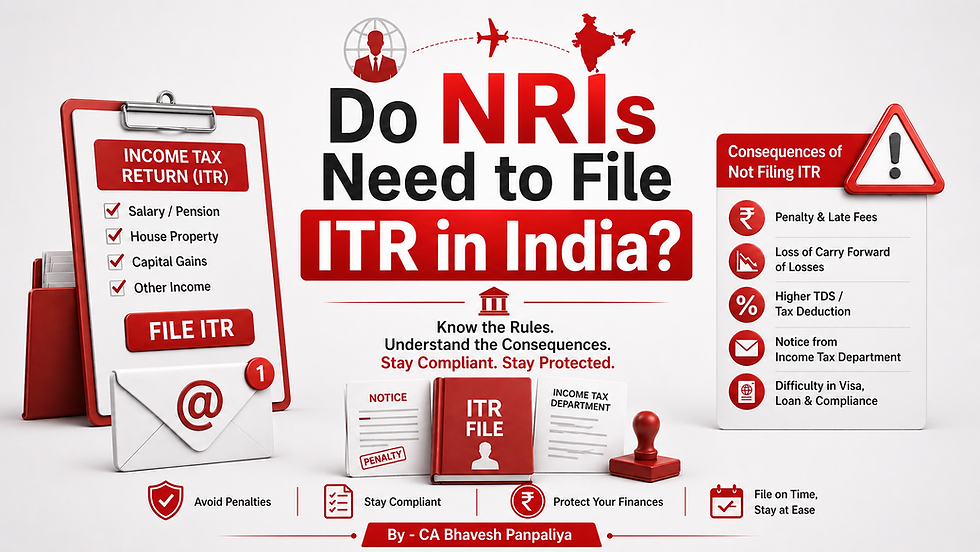
Many NRIs believe that once they move abroad, their tax responsibilities in India come to an end.
If there is no active business or job in India, filing an income tax return often feels unnecessary.
But this assumption is where problems begin.
Even without active involvement, small sources of income in India can create a legal requirement to file returns.
And ignoring this does not eliminate the obligation. It only delays it.
Do NRIs Need to File ITR in India? 📋 NRI Tax & Compliance - What Actually Matters✍🏻
The rule is simple.
If you have income that is taxable in India, you are required to file an income tax return.
This applies even if you are a non resident.
Common sources of taxable income include:
Rental income from property
Interest from NRO accounts or fixed deposits
Capital gains from sale of shares or property
Any business or professional income sourced in India
Even if the income appears small or passive, it still needs to be reported.
Is TDS Enough or Do You Still Need to File? 💰
Many NRIs assume that once tax is deducted at source, no further action is required.
This is not correct.
TDS is only a method of collecting tax. It is not the final calculation of your tax liability.
In many cases:
TDS deducted is higher than actual tax payable
Deductions and exemptions are not considered
Benefits under tax treaties are not applied
Without filing a return, excess tax paid cannot be claimed as a refund.
What Happens If NRIs Do Not File ITR? ⚠️ NRI Tax Reality Most People Miss!!
Initially, there may be no visible consequences.
However, the system continues to track financial data.
Over time, mismatches are identified based on TDS records, bank reporting, and transactions.
This can lead to:
Notices from tax authorities
Flagging of transactions
Unclaimed refunds
Complications in future filings
In cases involving large transactions, such as property sales, the impact can be significant.
Property Transactions and ITR Filing 📊
Property transactions are one of the biggest triggers for compliance issues.
When an NRI sells property in India, tax is deducted at higher rates.
However, actual tax liability may be lower due to available exemptions.
Without filing a return:
Excess tax cannot be claimed as refund
Exemptions cannot be applied
Funds remain locked unnecessarily
This is one of the most common situations where NRIs lose money simply due to non filing.
DTAA Benefits and Why Filing Is Required 🌍
India has tax agreements with multiple countries to avoid double taxation.
These agreements allow you to claim credit or reduce tax liability.
However, these benefits are not automatic.
To claim them, you typically need:
A filed income tax return in India
Supporting documents such as tax residency proof
Without filing, you may end up paying tax in both countries or face difficulties in claiming credit abroad.
Notices and What They Mean 🔍
Receiving a notice does not always indicate a major issue.
In many cases, notices are issued for:
Non filing despite available income data
Mismatch between reported income and records
High value transactions without corresponding returns
These notices are requests for explanation.
Responding early with proper documentation can resolve the matter efficiently.
Can Non Filing Be Corrected Later? 🛠️
Yes, in most cases it can be corrected.
Options include:
Filing belated returns within allowed timelines
Filing updated returns within specified periods
Responding to notices and regularising compliance
However, delays come with additional cost.
Interest and penalties may apply, and the process becomes more time consuming.
Common Mistakes NRIs Make ❌
Assuming no income means no filing requirement
Ignoring small sources of income
Relying only on TDS without filing returns
Delaying filing for multiple years
Not maintaining proper records
These mistakes often lead to avoidable complications.
What NRIs Should Do Every Year ✅
Check if you have any income in India
Review TDS deductions
Identify any financial transactions
File returns if required
Even if there is no immediate benefit, filing ensures that your financial records remain complete and compliant.
Conclusion ⚖️
Not filing an income tax return does not remove your obligation.
It only postpones it.
For NRIs, compliance is not about complexity. It is about consistency.
A simple annual check and timely filing can prevent multiple issues later.
Ignoring it may seem easier today, but it creates a larger problem in the future.
FAQs
Do NRIs need to file ITR in India?
Yes, if they have income that is taxable in India.
Is TDS enough for NRIs?
No, TDS does not replace the need to file an income tax return.
What happens if I do not file ITR?
You may receive notices and face penalties or lose refunds.
Can I file ITR later?
Yes, but additional charges and compliance requirements may apply.


Comments