
Foreign Income Non Disclosure Penalties - What India's Black Money Act Can Cost You ‼

"I have a bank account in the UAE from my years working there. I moved back to India three years ago. I never mentioned it in my ITR because there was no income in it. My CA just told me I may have a serious problem. How?"
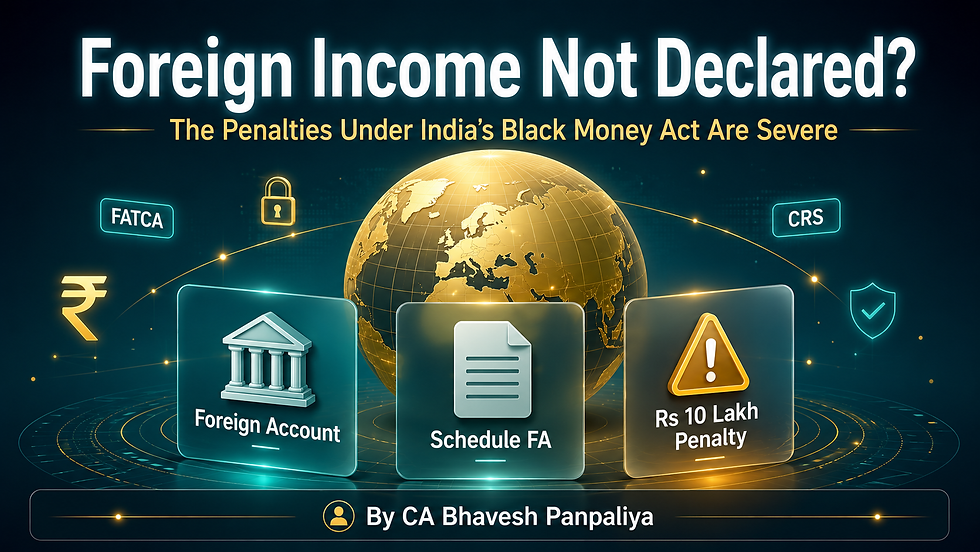
This conversation happens more than most people expect. And the problem is not always about earning foreign income secretly - sometimes it is simply not knowing that disclosure is mandatory even when income is zero, even when the account is dormant, and even when the money was legitimately earned.
Foreign income non disclosure penalties in India are not light. The Black Money (Undisclosed Foreign Income and Assets) and Imposition of Tax Act, 2015 - commonly called the Black Money Act - created a separate, severe penalty and prosecution framework specifically for undisclosed foreign assets and income. Understanding what must be reported, how India finds out, and what the consequences of non-disclosure are is no longer optional for anyone who has lived, worked, or invested abroad.
Who Is Required to Disclose Foreign Income and Assets in India
The disclosure obligation applies to Resident and Ordinarily Resident (ROR) taxpayers under the Income Tax Act. If you are an ROR in India for a given financial year, you are required to disclose all foreign assets held at any time during that year and all foreign income earned during that year - regardless of whether tax was paid on it abroad.
This includes:
Foreign bank accounts - savings, current, fixed deposits, or any other type
Foreign equity shares, mutual funds, bonds, or other financial interests
Foreign immovable property - land, residential, or commercial
Foreign business interests - directorship, partnerships, or ownership stakes
Foreign trusts - whether as settlor, trustee, or beneficiary
Foreign pension or retirement accounts
Any other foreign capital asset including cryptocurrency held on foreign platforms
Non-Residents and RNORs are not required to disclose foreign assets in the Schedule FA of their ITR - the obligation is specific to ROR taxpayers. But the year a returning NRI transitions from RNOR to ROR is typically the year this obligation kicks in - and it catches many people completely unprepared.
How the Foreign Income Non Disclosure Penalties Work
Under the Black Money Act
The Black Money Act 2015 operates as a separate layer of consequence on top of the Income Tax Act. Under this law:
Undisclosed foreign income or assets are taxed at a flat rate of 30% - no exemptions, no deductions, no basic exemption benefit
A penalty equal to 300% of the tax is levied on top - meaning the total outflow can be 120% of the asset value itself
A separate penalty of Rs 10 lakhs applies for failure to furnish information about foreign assets in the ITR - even if no income was earned from them
Criminal prosecution is possible with imprisonment ranging from 3 to 10 years for wilful non-disclosure.
The Rs 10 lakh penalty requires no income: This is the point that surprises most people. Even if your foreign bank account had zero balance or zero interest - if you were an ROR and you failed to disclose it in Schedule FA of your ITR, the Rs 10 lakh penalty applies per violation. The Black Money Act does not require the tax department to prove you earned income. Non-disclosure of the asset itself is the offence.
How India Actually Finds Out - FATCA and CRS
This is the part that has fundamentally changed the risk calculation for anyone holding undisclosed foreign assets. India is a signatory to two major international automatic information exchange frameworks:
FATCA - Foreign Account Tax Compliance Act
Under the India-US FATCA agreement, US financial institutions automatically report details of accounts held by Indian residents to the US Internal Revenue Service, which shares the information with India's tax authorities. If you hold a US bank account, brokerage account, or retirement fund as an Indian resident, that information flows to the Income Tax Department automatically - typically within a year of the relevant financial year.
CRS - Common Reporting Standard
The CRS is a global framework under which over 100 countries - including UAE, UK, Singapore, Canada, Australia, Switzerland, and most of Europe - automatically exchange financial account information with each other. India participates in CRS. This means bank accounts, investment accounts, and other financial interests held by Indian residents in any CRS-participating country are reported to India's tax authorities annually.
What this means practically: If you are an ROR in India and you hold a bank account in the UAE, UK, Singapore, or almost any developed country - the Indian Income Tax Department already has or will receive details of that account including balances and income. The era of "they won't know" is over. The question today is not whether the department will find out - it is whether you disclosed it correctly before they did.
Where Foreign Income and Assets Must Be Declared in Your ITR
The disclosure for ROR taxpayers happens in two places within the ITR:
Schedule FA (Foreign Assets) - This schedule requires disclosure of all foreign assets held at any point during the financial year. It covers foreign bank accounts, foreign equity and debt interests, foreign immovable property, foreign trusts, and other foreign capital assets. Assets sold during the year but held at any point must still be disclosed.
Schedule FSI (Foreign Source Income) - This schedule requires declaration of all income earned from foreign sources during the year - foreign salary, foreign dividends, foreign interest, foreign rental income, and foreign capital gains. This is where foreign income is brought into the Indian ITR and assessed.
Both schedules must be filed using ITR-2 or ITR-3 as applicable. There is no option to file ITR-1 if you have foreign assets or foreign income as an ROR.
Foreign Income Non Disclosure Penalties - What Happens When the Department Finds Out First
If the Income Tax Department receives information about your foreign account or income through FATCA or CRS before you have disclosed it, the sequence of events is typically:
A notice is issued under Section 148A asking you to show cause why your income should not be reassessed
If your response does not adequately explain the non-disclosure, a reassessment order is passed adding the undisclosed foreign income to your total income
Tax at 30% is levied under the Black Money Act on the undisclosed amount
A penalty of 300% of the tax is imposed under Section 41 of the Black Money Act
A separate penalty of Rs 10 lakhs per asset is imposed for Schedule FA non-disclosure
In serious cases, the Assessing Officer can refer the matter for criminal prosecution
The combined financial consequence of foreign income non disclosure penalties under the Black Money Act can exceed the value of the foreign asset itself. This is not a theoretical risk - the department has been actively pursuing cases identified through FATCA and CRS data since 2019.
What to Do If You Have Undisclosed Foreign Assets Right Now
If you are an ROR and you have foreign assets or income that you have not disclosed in past ITRs, the most important thing to understand is that voluntary disclosure - while it still carries a tax cost - is significantly less damaging than being caught.
The options available include filing updated returns under Section 139(8A) for eligible years, which allows taxpayers to update their ITR within two years of the relevant assessment year on payment of additional tax. This does not eliminate the penalty risk under the Black Money Act entirely but demonstrates voluntary compliance - which courts and assessing officers treat more favourably than discovered non-disclosure.
Do not attempt to handle this without a CA who specifically understands international tax and Black Money Act exposure. The sequencing of disclosures, the calculation of penalties, and the interaction with DTAA provisions requires expertise - and the wrong step can escalate a manageable situation into a criminal one.
First step if you are unsure about your disclosure status: Download your Annual Information Statement from the Income Tax portal. Check whether any foreign account or asset information appears there from FATCA or CRS reporting. If data is already showing in your AIS that you have not declared - take immediate advice before your next ITR filing date. Acting before a notice arrives always produces a better outcome than responding to one.
Frequently Asked Questions
What are the penalties for foreign income non disclosure in India?
Under the Black Money Act 2015, foreign income non disclosure penalties include tax at 30% on the undisclosed amount, a penalty of 300% of that tax, and a separate penalty of Rs 10 lakhs for failure to disclose a foreign asset in Schedule FA of the ITR. In cases of wilful non-disclosure, criminal prosecution with imprisonment of 3 to 10 years is also possible.
Does India automatically receive information about my foreign bank accounts?
Yes. India participates in FATCA with the United States and in the CRS framework with over 100 countries including UAE, UK, Singapore, Canada, and most of Europe. Financial institutions in these countries automatically report account details of Indian residents to India's tax authorities annually. The Income Tax Department receives this data and matches it against filed ITRs.
Is a foreign bank account with zero balance required to be disclosed in ITR?
Yes, if you are a Resident and Ordinarily Resident. Schedule FA requires disclosure of all foreign bank accounts held at any point during the financial year - including accounts with zero balance or dormant accounts. The penalty for non-disclosure under the Black Money Act applies regardless of whether any income was earned from the account.
Which ITR form must be used to declare foreign assets and income?
ITR-2 or ITR-3 must be used by ROR taxpayers with foreign assets or foreign income. ITR-1 cannot be filed if you have any foreign assets or foreign source income. Schedule FA covers foreign asset disclosures and Schedule FSI covers income from foreign sources. Both must be filled completely for each relevant asset and income source.
What should I do if I have not disclosed foreign assets in previous ITRs?
Seek immediate advice from a CA experienced in international tax and Black Money Act compliance. Options include filing updated returns under Section 139(8A) for eligible years. Acting voluntarily before the tax department issues a notice - especially if CRS or FATCA data may already be with the department - produces significantly better outcomes than responding to a notice after the fact. Do not attempt to manage this situation without professional guidance.


Comments