
NRI Repatriation Rules India: How NRIs Can Legally Transfer Money Abroad🌎

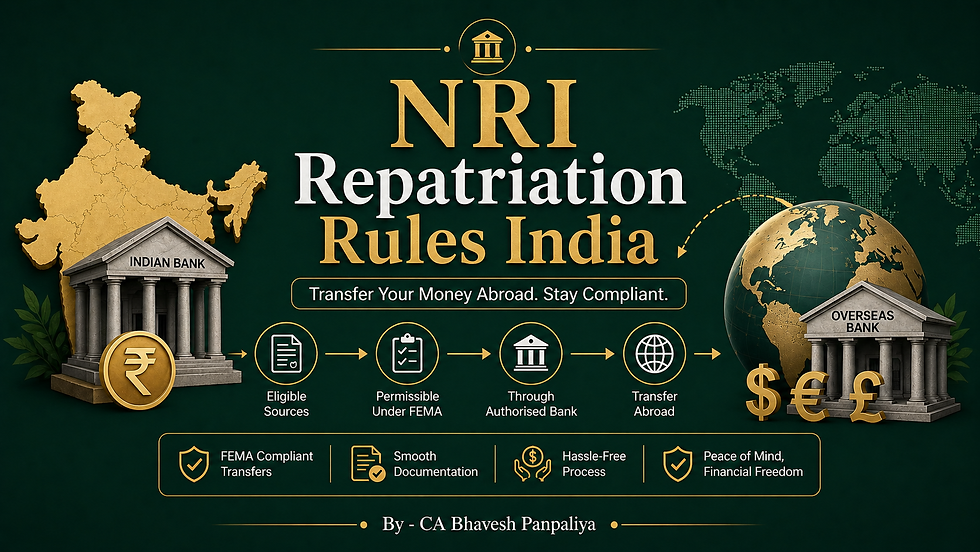
For many NRIs, investing in India feels simple.
Money comes in easily, investments grow, and everything looks structured.
But the real question comes later.
Can you take your money back without issues
This is where NRI repatriation rules in India become important.
Moving money out of India is not automatic. It depends on how the money was earned, where it is held, and whether compliance requirements have been met.
NRI Repatriation Rules India: Why Taking Money Out Is Not Simple 📋 Investments NRIs Cannot Make in India and the FEMA Rules You Must Know📚
A common assumption is that if the money belongs to you and tax has been paid, it can be freely transferred abroad.
This is not always correct.
Repatriation is governed by FEMA, which focuses on:
Source of fundsType of accountTax complianceDocumentation
This means the ability to transfer money depends on how it was structured from the beginning.
Types of Repatriation for NRIs 💰
Under NRI repatriation rules in India, funds are broadly divided into two categories.
Freely repatriable funds
Restricted repatriable funds
This distinction is not based on amount but on the source and account type.
NRE Accounts: Freely Repatriable Funds 🌍
Funds held in NRE accounts are freely repatriable.
This includes:
Income earned abroad and transferred to India
Investments made through NRE funds
Returns generated from such investments
NRIs can transfer these funds abroad without limits, subject to basic banking procedures.
This is the most flexible and convenient structure for managing foreign earnings.
NRO Accounts: Restricted Repatriation Rules 💸
Funds held in NRO accounts are subject to restrictions.
These typically include:
Rental income
Interest income
Property sale proceeds
Any income earned in India
Under NRI repatriation rules in India, NRIs can transfer up to a specified limit per financial year from NRO accounts.
However, this process requires:
Proof of source of funds
Tax compliance confirmation
Certification from a Chartered Accountant
This makes repatriation from NRO accounts more documentation-driven.
Documents Required for Repatriation 🗂️
Banks typically require the following before processing transfers:
Proof of income source
Tax payment details
Forms and certification from a Chartered Accountant
Proper documentation ensures smooth processing.
If records are incomplete, transfers may be delayed or rejected.
Property Sale and Repatriation 📊
Property transactions are one of the most common scenarios where repatriation becomes complex.
If the property was funded through foreign income, repatriation is easier.
If funded through local income, restrictions apply.
Documentation becomes critical, including purchase records, funding source, and tax compliance.
Without proper records, transferring funds abroad can become a lengthy process.
Why Paying Tax Is Not Enough ⚠️
Many NRIs assume that once tax is paid, funds can be transferred freely.
This is not correct.
Tax compliance and repatriation compliance are governed by different laws.
Even if taxes are fully paid, failure to meet repatriation rules can lead to delays or restrictions.
Common Mistakes NRIs Make ❌
Mixing personal and investment funds
Routing money through incorrect accounts
Not maintaining proper documentation
Not filing tax returns
Assuming repatriation is automatic
These mistakes create complications when transferring funds abroad.
How to Ensure Smooth Repatriation ✅
Use correct account structure from the beginning
Maintain clear records of all transactions
Separate foreign income and Indian income
Ensure regular tax compliance
Plan repatriation at the time of investment, not at exit
These steps help avoid delays and compliance issues.
Conclusion ⚖️
Repatriation is not about permission. It is about the process.
India allows NRIs to transfer funds abroad, but expects proper documentation and compliance.
Understanding NRI repatriation rules in India helps ensure that your money remains accessible when you need it.
Planning this in advance makes the entire process smooth and predictable.
FAQs -
Can NRIs transfer money abroad from India?
Yes, NRIs can transfer money abroad subject to repatriation rules and documentation.
Is the NRE account fully repatriable?
Yes, funds in NRE accounts can be freely transferred abroad.
What is the limit for NRO repatriation?
Repatriation from NRO accounts is subject to specified limits per financial year.
Do NRIs need a CA certificate for repatriation?
Yes, certification may be required for transferring funds abroad.


Comments