
The Boardroom Spectrum: Who is Actually Pulling the Levers?

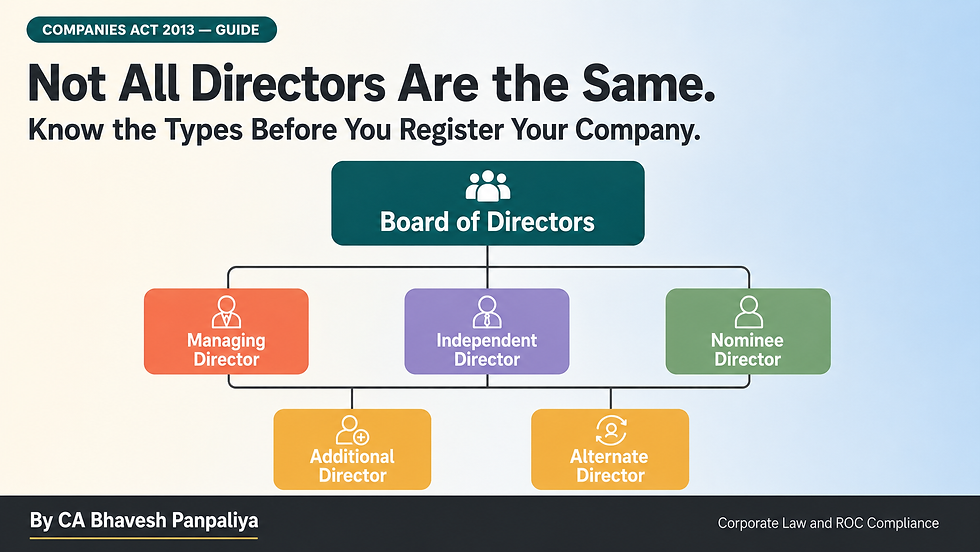
To an outsider, the Board of Directors looks like a unified front - a group of highly accomplished professionals sitting around a sleek mahogany table, voting on corporate strategies, and signing off on annual reports.
But if you are a shareholder, a scaling founder, or an aspiring executive, looking at the board as a single monolithic block is a dangerous mistake.
Imagine a company facing a sudden, massive regulatory non-compliance penalty. The corporate regulator steps in to demand accountability. Do they penalize the entire board equally? Will the person who sits in the office handling day-to-day operations face the exact same legal firestorm as the corporate advisor who only flies in four times a year for a committee meeting?
Here’s where most corporate observers get it wrong. They assume a director is a director, and that a title on a business card carries the same daily responsibilities across the board. The surprising part is that corporate law - such as the Companies Act - creates deep, distinct legal partitions between the people at that table.
Understanding the different types of directors in a company isn’t just an academic exercise in corporate law; it is the key to understanding where the true power, operational execution, and ultimate legal liabilities lie.
The Fundamental Divide: Internal Execution vs. External Oversight
At the most basic structural level, every corporate board is split into two primary camps: those who run the business full-time, and those who supervise the people running it.
                  ┌──────────────────────────────┐
                  │      BOARD OF DIRECTORS      │
                  └──────────────┬───────────────┘
                                 │
         ┌───────────────────────┴───────────────────────┐
         ▼                                               ▼
┌─────────────────────────────────┐             ┌─────────────────────────────────┐
│       EXECUTIVE DIRECTORS       │             │     NON-EXECUTIVE DIRECTORS     │
│  (Day-to-day internal leaders)  │             │   (Part-time external minds)    │
└────────┬────────────────────────┘             └────────┬────────────────────────┘
         │                                               │
         ├─► Managing Director (MD)                      ├─► Independent Directors
         └─► Whole-Time Director (WTD)                   ├─► Nominee Directors
                                                         └─► Additional/Alternate
1. Executive Directors (The Inside Operators)
These are the hands-on, salaried employees of the company who also happen to hold a seat on the board. They eat, breathe, and sleep the company's daily operations.
The Managing Director (MD) / Chief Executive Officer: Entrusted with substantial powers of management, they are the top-tier executives responsible for implementing the broad vision set by the board.
Whole-Time Directors (WTD): Directors who are in the full-time employment of the company, usually heading massive internal verticals like Finance (CFO), Operations (COO), or Technology (CTO).
2. Non-Executive Directors (The Outside Advisors)
Non-executive directors (NEDs) do not have a corner office at the company headquarters, nor do they get involved in hiring staff or signing vendor contracts. They are part-time board members brought in for their specialized industry expertise, strategic network, and objective detachment. They are compensated through sitting fees and performance commissions rather than a fixed monthly salary.
The Guardians: Independent and Nominee Directors
Within the non-executive ecosystem, things get highly strategic. This is where governance protects minority investors and heavy institutional lenders.
3. Independent Directors (The Neutral Observers)
An Independent Director is a highly specific category of non-executive director. To qualify as independent, an individual must have zero material or financial relationship with the company, its promoters, or its subsidiaries.
The Governance Mandate: Independent directors serve as the corporate conscience. They are legally mandated for listed public companies to ensure that the majority promoters do not siphon funds, manipulate financial statements, or run over the rights of minority retail shareholders.
4. Nominee Directors (The Special Interest Sentinels)
When a venture capital firm invests millions into a startup, or a major commercial bank extends a massive credit line to a business, they don't just sit back and hope for the best. They negotiate a contractual right to appoint a Nominee Director to the board.
The primary mission of a nominee director is to protect the financial interests of the specific institution that appointed them, ensuring that corporate funds are deployed strictly according to the agreed-upon terms.
The Temporary Assets: Additional and Alternate Directors
Sometimes, boards need structural flexibility to handle unexpected life events or sudden vacancies between official shareholder meetings.
5. Additional Directors (The Provisional Appointees)
If a company suddenly expands into a new vertical and urgently needs a cyber-security expert on the board, they don't have to wait months for the next annual general meeting (AGM) to get shareholder approval. The existing board can pass a resolution to induct an Additional Director immediately. However, this appointment comes with an expiration date: they only hold office until the conclusion of the very next AGM, where shareholders must officially vote to regularize them.
6. Alternate Directors (The Stand-Ins)
If a vital board member has to travel abroad or becomes unavailable for an extended period (typically three months or more), the board can appoint an Alternate Director to step into their shoes temporarily. The moment the original principal director returns, the alternate director’s voting power automatically ceases.
Real-World Scenarios: Where Liability Diverges
The practical impact of these titles becomes crystal clear when a corporate crisis unfolds.
Scenario A: The Financial Misstatement
A company’s accounting team aggressively inflates revenue numbers, resulting in a severe regulatory audit.
The Liability Split: The Executive Directors (like the Managing Director and the Whole-Time Finance Director) face severe, direct personal liability and potential criminal prosecution because they signed off on daily operational data. Conversely, an Independent Director who can prove they acted with due diligence and relied in good faith on certified audit reports is generally protected from the operational fallout.
Scenario B: The Venture Capital Clash
A startup founder wants to pivot the business from enterprise software into consumer hardware. The major venture capital firm holding 30% equity strongly objects.
The Action: The VC firm's Nominee Director uses their explicit board presence to raise objections, review the capital expenditure data, and enforce veto clauses written into the Shareholder Agreement (SHA), protecting the investor's capital from an unmapped operational pivot.
Key Takeaways for Business Operators
Execution vs. Governance: Executive directors build and run the machine; non-executive and independent directors make sure the machine complies with the law and protects investors.
Proportional Liability: Legal exposure scales with your daily operational control. Inside managers carry the heaviest personal burden under corporate statutory frameworks.
Strategic Board Architecture: A robust corporate board balances inside operational knowledge with external independent oversight to build sustainable market trust.
Conclusion
A high-functioning board of directors is a fine-tuned ecosystem of checks and balances. By intentionally combining the operational focus of executive directors with the unbiased, strategic vantage point of independent and nominee directors, a company can navigate aggressive growth cycles while keeping its legal compliance flawless. Whether you are building a startup board or evaluating a public company for your investment portfolio, knowing exactly who sits at the table - and under what legal mandate - is the ultimate shortcut to assessing corporate health.
FAQs
Can an independent director hold shares in the company?
To maintain strict objectivity, corporate laws impose rigid restrictions on independent directors. They or their relatives cannot hold a significant financial stake or voting power (typically restricted to less than 2%) in the company, its holding entity, or its subsidiary network.
What is a "Shadow Director"?
A shadow director is an individual who is not formally appointed to the board but whose behind-the-scenes instructions the registered directors are accustomed to following (such as a hidden majority stakeholder). Under modern corporate law, if a shadow director is found to be directing board choices, they face the exact same legal liabilities as an officially registered director.
Is a "Resident Director" a separate type of professional?
No, "Resident Director" is a statutory residency requirement rather than a functional role. Corporate law mandates that every board must feature at least one director who has resided in the home country for a specified period (e.g., at least 182 days in India during the financial year). This resident can be an executive, non-executive, or independent director.


Comments